
Biology presents itself as one of the hardest problems humanity needs to solve to secure it's future on this planet. It is our only sustainable solution for problems like climate change, health, production, and colonisation of outer space.
At its core, biology can be viewed as a form of molecular nanotechnology, optimised by the evolutinary algorithm over billions of years, which resulted in overwhelming amount of complexity.
Biological systems are a product of optimisation algorithm. There are relatively simple rules on how biology works, but the systems that emerge from these rules are unimagabely complex, and it is very hard to understand them with the top-down approach, by observing their behaviour and trying to define the primitives that created these behaviours. The solution is to, first agree on what are the underlying rules, and then simulate (in silico) the same process that is done in nature. The more precise/detailed the simulations, the better. But we don't have enough computational resources today, to simulate nature on the quantum level, or even atomic level, so we have to find ways to approximate them. Which leads us to why we are starting GenHub.
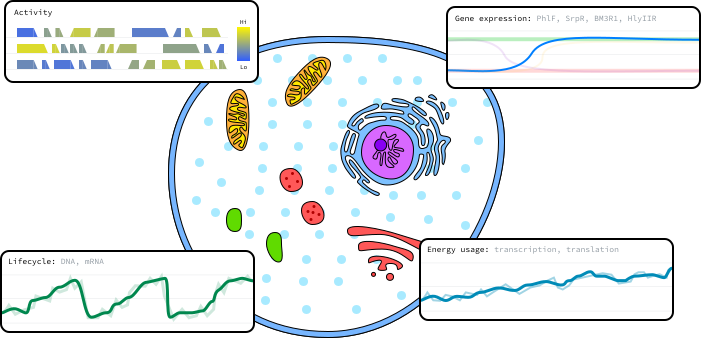
Illustration of a cell simulator.
We want to use the cutting-edge AI technices to simulate biological cells (with humans cells being our endgame). We are a non-profit organisation, and this is our 10-year goal. We believe this is the right time to start working on this problem, due to recent advancements in the field of AI, specifivaly with successes of models like AlphaFold and ESMFold, which created massive amounts of data about protein and molecular structures withing the cell. We want to analyse these structures to understand their interconnectedness, in the huge blob of mess that is a biological cell.
We are laser-focused on this mission, and we believe that, if we succeed, the upsides are going to be huge for biotech, pharma idustry, and humanity as a whole.